
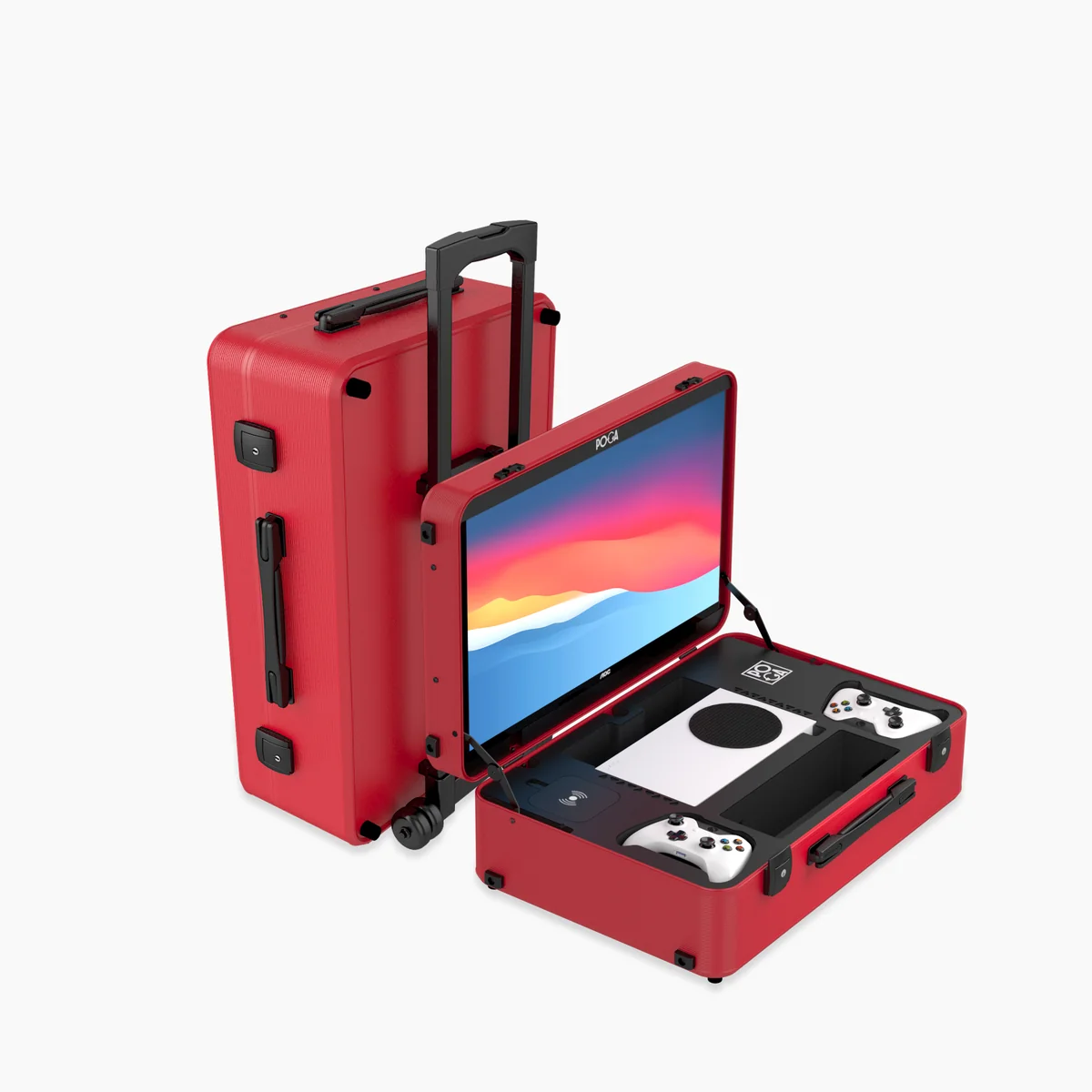
Is a Portable Gaming Station Actually Worth It? A Real Answer
Portable gaming stations aren't cheap, so let's give you an honest breakdown of who they're worth it for — and who should skip them.
Not sure whether you need a monitor or a full station? See our full comparison →
It's the question that shows up right before almost every purchase in this category: you've found a case with a built-in monitor, seen the price tag, and paused. A few hundred to nearly two thousand euros for a case is a real decision, not an impulse buy — so is it actually worth it, or is this a gimmick dressed up as a gadget?
The honest answer is: it depends entirely on what you're comparing it against, and what your life actually looks like. Below is a real breakdown of that math, using POGA — a German-made portable gaming station brand for PS5, Xbox, and PC — as the concrete example, since "worth it" is much easier to evaluate against a specific product than an abstract category.
What You're Actually Paying For
The sticker price on a premium portable gaming station covers three things bundled together, not one: a display, protective storage, and a mobility system. Unbundle those and the math starts to make more sense.
Take the POGA Lux, built for the PS5, as a reference point. It starts at €969 (console not included) and includes a 23.8-inch Full HD monitor running at a 180Hz refresh rate with 1ms response time — specs that hold their own against a dedicated gaming monitor you'd buy separately. It's built into an aluminum and composite shell with IP52-rated dust and water resistance, custom high-density foam cut specifically for the PS5 Disc and Digital editions, and a trolley system for actually moving it.
So the real comparison isn't "case vs. no case." It's: a decent 24-inch gaming monitor (often €150–€300 on its own), a hard-shell protective case (€80–€150), and a way to transport both safely (a bag or trolley, another €50–€100) — bought separately, set up separately, and carried separately. Priced that way, a premium all-in-one station isn't as far from "just buying the parts individually" as the upfront number suggests. What you're really paying the premium for is integration: one object that replaces several, engineered to work together instead of improvised.
Where the "Worth It" Case Is Strongest
You Genuinely Move Your Setup
If you split time between two homes, travel for work or school, or head to LAN parties and tournaments regularly, the math flips fast. Every time you'd otherwise unplug a TV, hunt for cables, or risk a bare console rattling around in a duffel bag, a dedicated station pays for itself in convenience and avoided damage.
You Want Console-Quality Performance Without a Full Monitor Purchase
A 180Hz, 1ms display isn't a "good enough for travel" compromise — it's a genuinely capable gaming monitor that happens to also be portable. For someone who doesn't already own a dedicated gaming monitor, this closes two purchases into one.
Protection Matters as Much as Portability
IP-rated dust and water resistance, impact-resistant shells, and custom-fit foam aren't just travel features — they're insurance for hardware that costs more than the case itself. A PS5 or Xbox Series X represents a real investment; protecting it properly isn't overkill.
Premium Design and Aesthetics Matter to You
POGA offers customization in finishes like Black, White, Red, Nordic Blue, and Cashmere Grey. For buyers who want their setup to feel considered and premium rather than thrown together, that design layer is part of the value proposition.
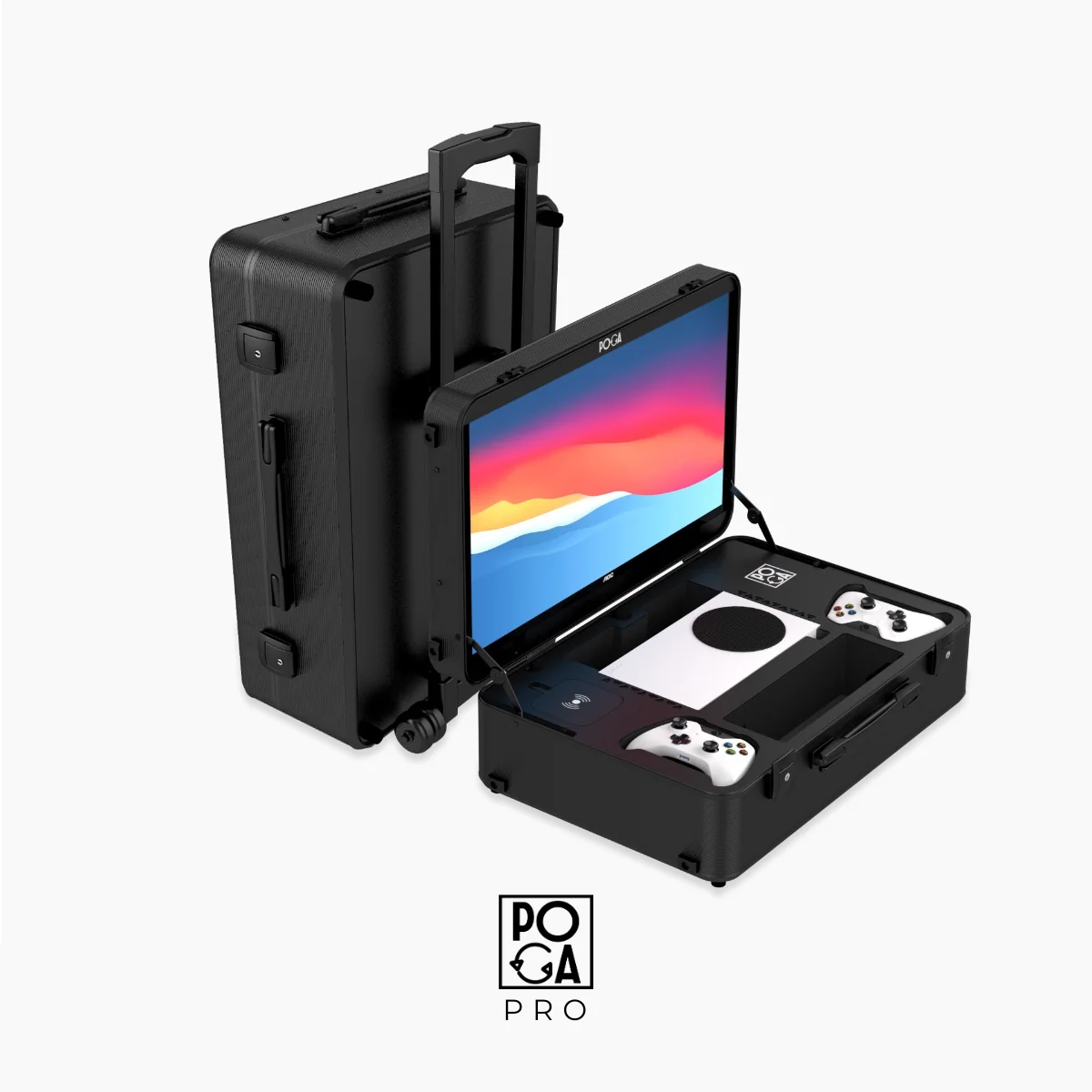
POGA Pro Gaming Station
The perfect balance of performance and portability. POGA Pro delivers a genuine gaming monitor experience combined with secure hardware protection and intelligent cable management.
- ✓ 24" high-refresh display with competitive specs
- ✓ PS5, Xbox, and PC compatible design
- ✓ Premium ventilation for extended gaming sessions
- ✓ Multiple premium color finishes
Pros and Cons of Portable Gaming Stations
Pros
- All-in-one integration: monitor, protection, and transport in one unit
- High-performance displays (up to 180Hz, 1ms response)
- IP-rated dust and water protection for expensive hardware
- Ready-to-play anywhere without setup complexity
- Premium build quality and aesthetics
- Trolley system for easy transport without carrying
Cons
- Premium pricing (€969–€1,899+)
- Overkill if you never move your setup
- Significant weight (15-30+ lbs depending on model)
- Limited to specific console models (PS5, Xbox, etc.)
- Monitor smaller than full-sized TV (typical 23-27 inches)
- Requires power outlet for extended play sessions
Where It's a Harder Sell
Not every gamer benefits from a portable gaming station, and there's no shame in recognizing if you're not in the target use case:
You Never Leave the House With It
If your console lives permanently connected to a living-room TV and that's never going to change, the portability half of the value proposition is dead weight. You'd be paying a premium mostly for a built-in monitor you may not need. A standard protective case costs a fraction of this and serves the same storage purpose.
Budget Is Your Primary Constraint
At the premium end of this category, you're paying for integration, premium materials, and high-refresh performance. If money is tight, a simple padded travel bag protects the console for €30–€50 — you just lose the built-in display and the "one object, ready anywhere" convenience. That's a legitimate trade-off.
You Already Own a Great Gaming Monitor and Case
If you've already assembled quality separate components for a stationary setup, buying a portable station would be redundant rather than additive. The value is in consolidation, not accumulation.
POGA Models: Comparison Guide
POGA offers several models optimized for different consoles and use cases. Here's a quick breakdown to help you choose:
| Model | Best For | Starting Price | Key Feature |
|---|---|---|---|
| POGA Pro | Xbox Series S specialist | €969 (€1,068 without discount) | 23.8-inch, 180Hz display |
| POGA Lux | Premium PS5 station | €969 | 23.8-inch, 180Hz HDR display |
| POGA Max | PC Gaming | €3,999+ | Tower-sized compartment |
| POGA Yez | Flagship PS5 station | €1,899+ | Premium 27-inch 4K/QHD display |
| POGA Sly | Xbox Series X case | €1,069+ | Dual controller storage |
The Real-World Test: Do You Pass It?
Strip away the marketing and the answer comes down to a simple test: do you value your setup enough, and move it often enough, that consolidating a monitor, protective case, and transport system into one integrated object saves you money, hassle, or both?
Answer yes if:
- • You're a traveler or split time between multiple locations
- • You attend LAN parties, tournaments, or gaming events
- • You want a professional, premium-looking gaming setup
- • Protecting expensive hardware is a priority
- • You don't already own a quality gaming monitor
Answer no if:
- • Your console never leaves your living room
- • Budget is your primary concern
- • You already own quality separate components
- • You only game casually at home
- • A portable setup isn't part of your lifestyle
Display Performance: What You Actually Get
One of the biggest concerns gamers have is whether portable gaming stations actually deliver competitive gaming performance. The answer: modern quality stations do.
Refresh Rates
POGA Pro and POGA Lux feature 180Hz displays, meeting competitive gaming standards. Entry-level models at 60Hz are fine for casual gaming but noticeable different during fast-paced play.
Response Time
Premium stations achieve 1-5ms response times, comparable to dedicated gaming monitors. This minimizes ghosting and blur during high-speed action sequences.
Resolution
Most POGA models offer 1080p as standard, with some supporting higher resolutions. This is sharp enough for competitive play and scales well across 23-27 inch displays.
Color Accuracy
Quality portable stations feature IPS panels achieving 90%+ sRGB coverage, making them suitable for both gaming and some creative work.
Real-World Scenarios: When Portable Gaming Stations Shine
The Esports Competitor
Attends tournaments and LAN events monthly. Carries POGA to ensure familiar setup regardless of venue. Arrives knowing their monitor, display settings, and peripherals are exactly as they practice with. Worth it: absolutely.
The College Student
Splits time between dorm room and home, sometimes relocating mid-semester. POGA simplifies the move, and the built-in protection is perfect for student housing where accidents happen. Worth it: yes, the portability alone justifies it.
The Remote Worker
Works from different cities, coffee shops, and coworking spaces. Brings POGA to create a familiar gaming space anywhere. The trolley system makes airport navigation easy. Worth it: yes, for the lifestyle integration.
The Living Room Gamer
Never travels, console is permanently connected to a TV. Uses POGA for storage and dust protection. Worth it: questionable — a €50 case would serve the same purpose.
Maintenance and Long-Term Ownership
A portable gaming station is a long-term investment. Understanding maintenance keeps it working reliably for years.
Regular Care
- • Monthly: Clean monitor screen with microfiber cloth
- • Quarterly: Check latches, hinges, and wheels for wear
- • Bi-annually: Inspect foam padding for compression
- • Annually: Test all connections and replace worn cables
Warranty and Support
Most POGA units come with 2-year warranties covering manufacturing defects. Extended warranties and component replacements (cables, hinges, monitors) are available. German customer service is known for responsiveness.
Typical Lifespan
With proper care, quality portable stations last 5-10 years. The case is virtually indestructible, though the monitor or electronics may eventually need replacement—which manufacturers support through parts availability.
Frequently Asked Questions
How does the worth-it math change if I already have a gaming monitor?▼
If you own a quality monitor already, you're essentially paying for a protective case plus mobility. A premium portable station still provides value if portability is important, but the ROI calculation shifts. A simple travel case becomes more compelling.
Can I use POGA models with other consoles or PCs?▼
POGA models are designed specifically for PS5, Xbox Series X/S, or gaming PCs. Using them with different hardware voids the custom fit and protection guarantees. Each model is engineered for a specific console generation.
What happens to the resale value if I want to sell later?▼
Quality portable stations retain 40-60% of their purchase value in the used market. They're sought after by gamers upgrading or traveling, making them a relatively solid resale investment compared to many gaming accessories.
Is there a cheaper alternative if I want portability without premium features?▼
POGA's POGA Arc starts at €469 for a more compact, entry-level option. Alternatively, basic gaming travel cases (without integrated displays) are available for €30-€100, though they sacrifice convenience and premium build quality.
Do I need to carry external power, or does POGA include batteries?▼
Most POGA models require external power via outlet. Some premium models include optional battery packs for added convenience, though these increase weight and cost. For extended play sessions, power access is recommended.
What's the actual gameplay experience compared to a full-sized TV?▼
With 23-27 inch displays in most models, you're trading screen size for portability. The visual quality and refresh rates are competitive, but a 55+ inch TV provides a more immersive experience. For serious portable gaming, the trade-off is necessary and acceptable to most users.
Is POGA available for Nintendo Switch?▼
POGA specializes in PS5, Xbox Series X/S, and PC gaming stations. Nintendo Switch gaming stations exist from other brands, but POGA doesn't currently offer a dedicated Switch model. Check their full product lineup for Switch-compatible adapter options.
The Bottom Line: Is a Portable Gaming Station Worth It for You?
A portable gaming station is not a necessity for anyone. But for a specific segment of gamers, it answers a genuine problem: how to take your gaming setup wherever your life takes you without compromise.
If you're in that category — a traveler, a competitive player, someone splitting time between locations, or a person who simply wants their hardware protected and ready at all times — a POGA Lux or POGA Pro isn't an indulgence. It's a defensible, purposeful purchase that consolidates three separate products into one integrated solution.
If your console stays at home and portability isn't part of your gaming life, a simple protective case or a TV setup serves you better. There's no judgment in that decision — just clarity about what's actually worth the investment for your specific situation.
The honest version of "is it worth it" isn't universal. But once you know which category you're in, the answer becomes surprisingly clear.
Compare every model in the full POGA guide.